Sunday 6 June 2010
The answer to the question posed, is there trouble with a big “T” or a little “t”
in store for the S&P? Turns out, it was large. That there would be a decline
came as no surprise. What came as a surprise was the rapidity and extent of
it. The small range high was the tip-off. [See S & P – Rally In Trouble?, click
on http://bit.ly/aplYRE, third paragraph]. The Thursday small range bar, a red
flag because it occurred at a known resistance area, raised the possibility of a
retest of the 1060 area if price failed, [see third paragraph after first chart,
same article].
It is not good practice to have a new, or relatively new, position established
going into a report. There must have been some kind of advance leak, for
price sold off several hundred points prior to the release of the employment
report. After the report, the decline afforded little opportunity for a position
without entailing undue risk. In order to know what to do next, we revert back
to the basics: what is the TREND?!
It is clear that sellers resumed total control of the market as it declined with
impunity. We saw that back on 24 May when we mentioned that “surprises”
most always occur in the direction of the trend. [See S & P – The Market Is
Showing Its Hand, click on http://bit.ly/9PpjCm, first, and last paragraph].
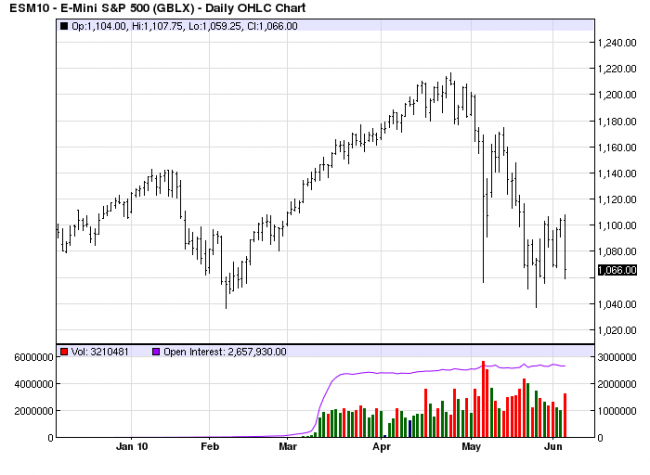
Contrast the difference between Thursday’s small range rally bar with that of
Friday’s wide range decline bar, and you see the difference between a lack of
demand on the one, and supply selling on the other. Knowledge of the trend
is crucial, for it makes for reading market activity somewhat easier.
The logical question to pose is, what do we know for certain?
In a market that exhibits such weakness, we know that price will continue to
decline until there is evidence of buyers entering and arresting the selling
activity. Thursday’s small range rally is a perfect example of buyers failing
to take control when they had an opportunity to do so. That left the door
open for sellers, and for Friday, that door was a floodgate.
However, we have seen such declines in the past few weeks, and from our
perspective, they uncovered demand, [buyers] at the lower levels. Right
after a steep decline on the 24th, we determined there was buying at the
lower levels, [ See S & P – A Set-Up In The Making, click on
http://bit.ly/aLZKzQ, fifth paragraph]. It is important to remember that
smart money buying comes from lower levels. It is axiomatic that smart
money is buying when weaker hands are selling.
Will that continue to be the case here?
We do not often reference the Nasdaq chart, but here it is. The Nas,
comprised of mostly technology stocks, has been leading the stock market
rally since November/December 2008. The S&P closed under the week’s low
ranges, above. The Nas held last week’s lows, forming a short-term double
bottom. Didn’t we recently discuss a double bottom? Why, yes. [See S&P –
The Market Message Remains On Point? click on
http://www.insidestocks.com/commentary/story.asp?id=153676, first
paragraph after first chart.] Will this double bottom on a shorter time frame
work? We can never know in advance, nor do we need to, so we always
follow developing market activity to provide the answer.
Note is made that Friday was an Outside Key Reversal, [OKR], for both the
Nas, and the S&P. An OKR can be a very strong message. [OKR = higher
high, lower low than previous day, and in this instance, a lower close, as well.]

While we wait for developing market activity to tell us if the May lows will hold
or not…clues will be the size of the bars and volume…a look at whether
buyers are still showing up at these lower levels is in order. The direction and
momentum of the market is down, as acknowledged, and will continue until
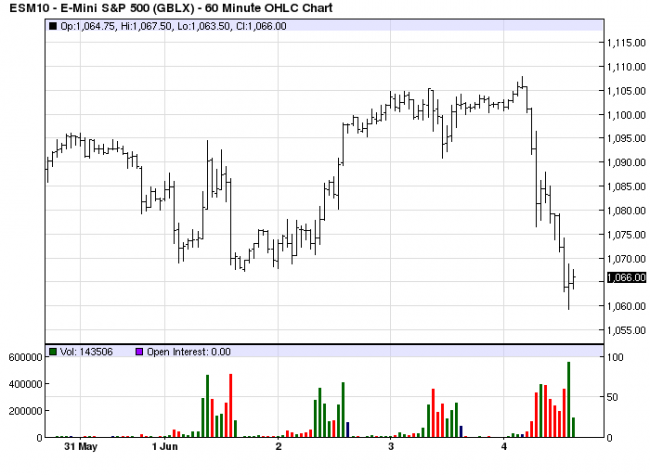
opposing evidence shows up. What can be asked about the hourly chart is,
is there any such opposing evidence?
Look at the highest volume bar from Friday’s intra day activity. It occurred
right at the low. We see that as a transfer of risk, weak longs selling out
under pressure, while strong hands scoop up the offerings. The close of that
low bar was mid-range, and that tells us there was buying at the lows. Who
would be doing that level of volume buying, and at the lows of a somewhat
panic decline? You get the point.
This is the caveat to the sellers being in control, and why we raise the
question…not to recommend any buying at the bottom, but as an alert to a
possible turnaround rally as has occurred throughout the month of May, and
last February.
Why not also look at the stronger Nas 60m chart to see what it shows? There
is the double bottom set-up from an intra day perspective. Just as with the
S&P, the Nas’ highest volume was at the low of the decline, and the close was
positive. There is also a clustering developing there, and that can some-
times be a clue for a turnaround. [Note in both instances, the S&P and Nas,
the high volume at the very low was also the highest hourly volume in several
trading days. That can be added significance,]
Sellers now have every opportunity to press the market to crush buyers and
make new lows. It would seem that most would take that point of view. What
is not expected is a hold in the decline and a reversal, once again, to rally
prices to the 1150, or higher, level. How many expect that when price is so
low?
The odds favor more decline, and we would never stand in the way of market
momentum and the trend. It is just as important to be aware of a few
observed hints, outlined above, in case the unexpected does take place.
What we also know for certain in futures trading is, anything can happen!!
Always, always, let the market be the best guide, and follow its path.
If there is to be more downside, an opportunity to short a weak rally will
present itself. If the recent lows are to hold, in some fashion, an
opportunity to get long will present itself, as well.
Patience is the standing order, at this point.